Ask what a house costs in Chandler right now and you'll get a clean number back. As of September 2026, the citywide median sits at $526,310, about $297 a square foot, with homes taking a median of 57 days to sell. That number is accurate. It is also close to useless if you're trying to figure out what your money buys in Ocotillo versus Fulton Ranch versus the tract-home subdivisions that make up most of the city.
Here's the question worth asking before you compare neighborhoods by median price: what, exactly, is being averaged together?
One Number, Very Different Houses
Chandler's median looks calm from a distance. A separate three-month tracking window puts the typical sale closer to 49 days on market with buyers submitting about two offers, and Maricopa County as a whole runs cooler, with a countywide median of $465,000 and 75 days on market. Chandler is outperforming its county on speed and price, which is the kind of fact that gets repeated in every market update.
What doesn't get repeated as often is that "Chandler" isn't one housing product. It's an entry-level tier of older resale homes, condos and townhomes below roughly $450,000. It's a middle tier from about $450,000 to $750,000 that makes up the bulk of the city's single-family tract homes, the traditional suburban product most people picture when they say Chandler. And it's a lake-and-luxury tier above $750,000, concentrated almost entirely in two master-planned communities: Ocotillo and Fulton Ranch.
| Price Tier | Approximate Range | What You're Actually Buying |
|---|---|---|
| Entry | Below $450,000 | Older resale stock, condos and townhomes in established subdivisions |
| Core | $450,000 to $750,000 | The bulk of Chandler's single-family tract homes, the segment the citywide median mostly describes |
| Lake and Luxury | $750,000 and up | Golf and lakefront homes concentrated in Ocotillo and Fulton Ranch, plus scattered custom estates elsewhere in South Chandler |
These three tiers aren't moving together. The middle tier has been the softest part of the market this year, with sellers who priced off last spring's comps sitting longer and eventually chasing the market down. The top tier has done the opposite. Homes priced over $1 million now command the largest share of total housing dollars spent across the Phoenix metro, a shift that would have been unusual just a few years ago, and Chandler's lake communities are a big part of why. Buyers relocating from Seattle, Chicago and coastal California into jobs along Chandler's employment corridor, home to Intel, PayPal, Microchip Technology, Northrop Grumman and Wells Fargo, are landing directly in that $750,000-plus band, where a lakefront estate can look like a bargain next to what they sold.
There's a metro-wide version of this story too. Across Maricopa County, new-home sales lost ground to resale through 2026. New construction made up about 15.8 percent of the county's market in June 2026, down from 20.8 percent a year earlier, a drop of more than five percentage points. New-home prices fell 3.4 percent year over year in the same window while resale prices ticked up about 1.1 percent. Translation: buyers with the budget to compete are increasingly choosing an established address over waiting on a builder, which is exactly the pattern showing up in Chandler's two lake communities.
Inside Ocotillo, the Median Splits Again
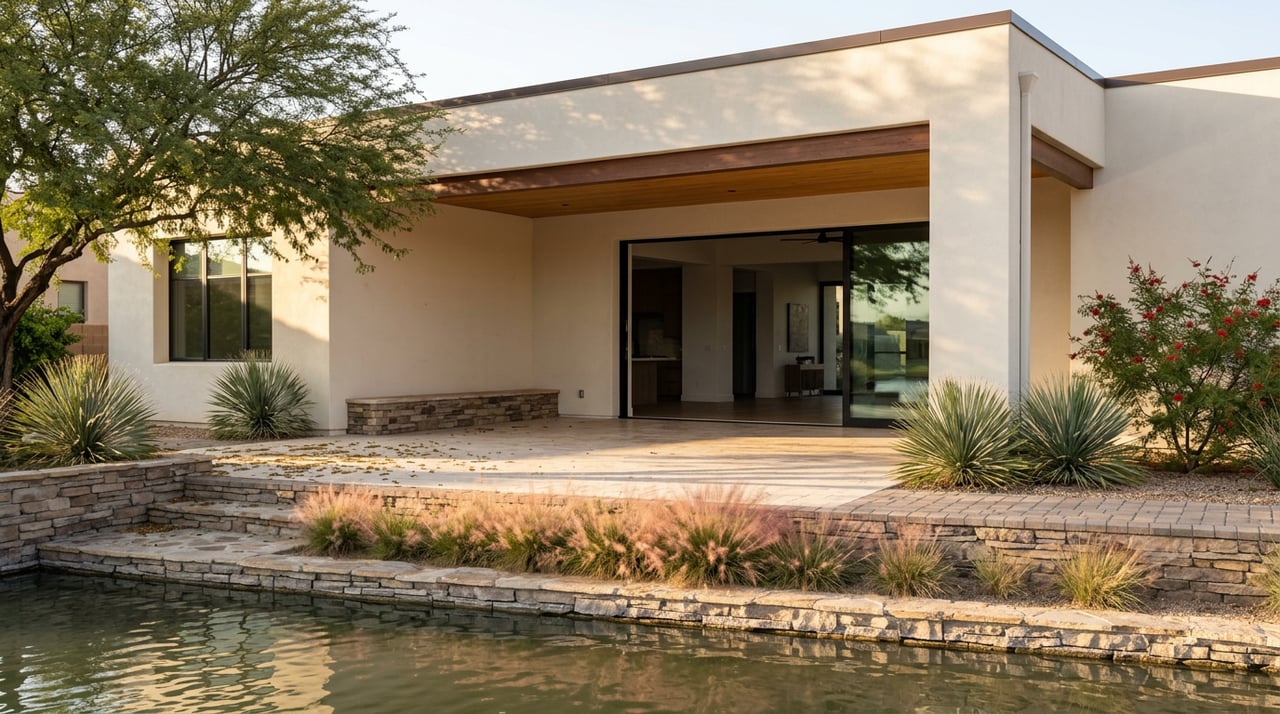
Ocotillo is Chandler's original water-and-golf master plan, built around a Ted Robinson-designed golf club with three nine-hole courses and more than 160 acres of interconnected lakes, enough that residents have nicknamed the neighborhood "A-qua-tillo." Downtown Ocotillo has its own walkable pocket, anchored by a farmers market and gathering spots like The Living Room Wine Café & Lounge, and residents get direct access to the Paseo Trail.
As of July 2026, Ocotillo's own median home price was $685,000, but the average sale price was $749,894. A $65,000 gap between median and average in a single neighborhood is a signal on its own: it means a handful of higher-priced sales are pulling the average up while the typical transaction stays lower. That's before you even split by subdivision. Townhomes in communities like Cantabria Shores and Echelon at Ocotillo have traded as low as $399,900. Golf and lakefront single-family homes in enclaves such as Ocotillo Lakes and The Island at Ocotillo run from around $750,000 up to $2 million.
That's a spread of more than $1.6 million under one neighborhood name. If you're comparing "Ocotillo" to another Chandler community using a single median, you're not comparing two neighborhoods. You're comparing a fruit basket to a single apple and wondering why the math doesn't line up.
Fulton Ranch's Math Problem
Fulton Ranch is Chandler's other lake community, a "community of communities" built starting in the early 2000s around interconnected lakes and walking paths, with enclaves named Serenity, Shoreline, The Island, Reserve, Gallery and Crescent Falls. More than 1,000 homes sit inside it, ranging from the mid-$500,000s to more than $2 million, with retail anchored by Fulton Ranch Towne Center, The Promenade at Fulton Ranch and the Marketplace at Fulton Ranch.
Here's the part that matters if you're using Fulton Ranch's numbers to plan a purchase or a sale: only 12 homes sold there in May 2026, down from 14 the year before. When a neighborhood's entire monthly sample is a dozen transactions, one closing does most of the work of setting the average.
You can see it in how differently three trackers describe the same season. One puts Fulton Ranch's median sale price at $676,000. Another puts the three-month median, for the window ending in May 2026, at $710,000, a $34,000 gap on the same neighborhood in the same stretch of the year. That same source shows the single most recent month's average sale price at $630,000, down 17.6 percent year over year, a swing that would suggest a community in freefall if you didn't know the sample size behind it. Active Fulton Ranch listings this year have run from a $429,900 townhome near the Marketplace to a custom lakefront estate listed near $5.5 million. Put one of those into a 12-home month and the "average" stops describing a typical house and starts describing whichever few homes happened to close.
This isn't a case of bad data. It's what small numbers do. A community that sells 100 homes a month can absorb an outlier without much drama. A community that sells 12 cannot.
What to Ask Instead of "What's the Median"
If you're comparing Chandler neighborhoods and you've already looked past the citywide number, here's where to focus instead:
- Ask which subdivision or enclave a comp actually sits in, not just which master plan. Ocotillo Lakes and Cantabria Shores are both "Ocotillo," and they are not the same product.
- Ask how many homes actually sold in that community over the past 90 days. Under 20 sales a month means you should treat the reported average as a range, not a single number.
- Ask what you're crossing when you move up a tier. Going from a $600,000 tract home to a $780,000 lake home in Ocotillo or Fulton Ranch isn't just a 30 percent price jump on the same product. It's a different HOA, a different assessment history, and often a resale disclosure packet that looks nothing like the last one you read.
That last point has a real dollar figure attached. Under Arizona law, once a sale is pending, a homeowners association has ten business days to deliver the resale disclosure packet and can charge no more than $400 total for it. What isn't capped is a separate transfer fee, if the community's governing documents authorize one, which can add anywhere from a few hundred to several thousand dollars at closing depending on the community. That's worth confirming before you fall for a listing photo of a private dock. If you want a sense of what your own Chandler property would net after those costs, a home valuation is a faster starting point than trying to eyeball it from a portal median.
Frequently Asked Questions
Is Ocotillo or Fulton Ranch the better value right now? Neither, as a blanket answer, because "Ocotillo" and "Fulton Ranch" each span too wide a price range to compare as single units. A townhome near the Marketplace at Fulton Ranch and a lakefront estate in The Island at Ocotillo aren't competing for the same buyer. The comparison that actually means something happens at the enclave level, using recent closed comps rather than the community-wide monthly average.
Why did new construction lose ground to resale in Chandler-area communities this year? Countywide, new-home prices fell while resale prices held closer to flat, and buyers with financing in place followed the better relative value into established neighborhoods. Both of Chandler's lake communities are fully built out at this point, so any buyer choosing that lifestyle is choosing resale by default, which has only added to demand in a year when new construction was already losing market share.
Does a higher price in these communities always mean a different HOA structure? Not automatically, but often enough that it's worth checking before you write an offer. Ocotillo and Fulton Ranch both operate multiple HOA layers tied to specific enclaves, and dues, reserve funding and rental restrictions can vary meaningfully between them even at similar price points. The resale disclosure packet is where that gets confirmed, not the listing sheet.
Median prices are a useful starting point and a poor stopping point, especially in a city where two of its most recognizable communities can each contain a $1.6 million range under one name. If you're weighing a move between Chandler's price tiers, or trying to figure out where your current home actually sits in one, Vanessa Roark can walk through the enclave-level comps that the citywide number was never built to show you. Book a complimentary Home Marketing & Strategy Session to start with the numbers that actually apply to your address.